
Between 2022 and 2025, TactoTek was part of the Horizon Europe–funded UNICORN project*, which focused on the innovation potential of circular approaches in automotive electronics. In the project, industry and research partners explored together how electronics can support both sustainability goals and next-generation user experiences at the same time.
A list of partners in Project UNICORN can be found at the end of this article.
Automotive electronics are becoming a dominant part of vehicle value, expected to reach up to 50% of total car cost by 2030. At the same time, regulatory pressure around sustainability, safety, and circularity is increasing.
If we continue manufacturing traditional multi-assembled parts – "sandwiching" separate PCBs, wires, light guides and plastic housings – the environmental debt will only increase.
The UNICORN project consisted of several sub-themes, and TactoTek was part of a group whose detailed topic was “Printed Electronics for Human Detection and Alerting”. The task was to add functionality, applying four pillars of circularity: energy efficiency, material circularity, lifetime optimization, and improved utilization.
One of the emerging trends in automotive interiors is blending HMI elements and ambient lighting into interior surfaces, making these aesthetic parts functional and smart. IMSE is an enabler of this transition: it turns decorative surfaces into living, smart surfaces that communicate through light, sense, and interaction.
Together with project partners IEE, TNO, and New Cable Corporation, TactoTek built a physical system demonstrator that illustrates this transition through a sophisticated integration of several technologies. In the demonstrator, flexible, printed seat belt reminder (SBR) sensors from IEE are interconnected with an IMSE door panel developed by TactoTek. This integrated panel serves a dual purpose: it provides bright alerts when the sensors are triggered and can also serve as a secondary warning light, while functioning as elegant ambient lighting during normal operation.
To ensure system integrity, the components are connected using shielded flat flexible cable (SFFC) technology from New Cable Corporation. Furthermore, an IME lab version by TNO accompanies the demonstrator to showcase sustainable innovation by using recycled polycarbonate resin and reversible adhesives to highlight the potential for circularity in smart surface manufacturing.
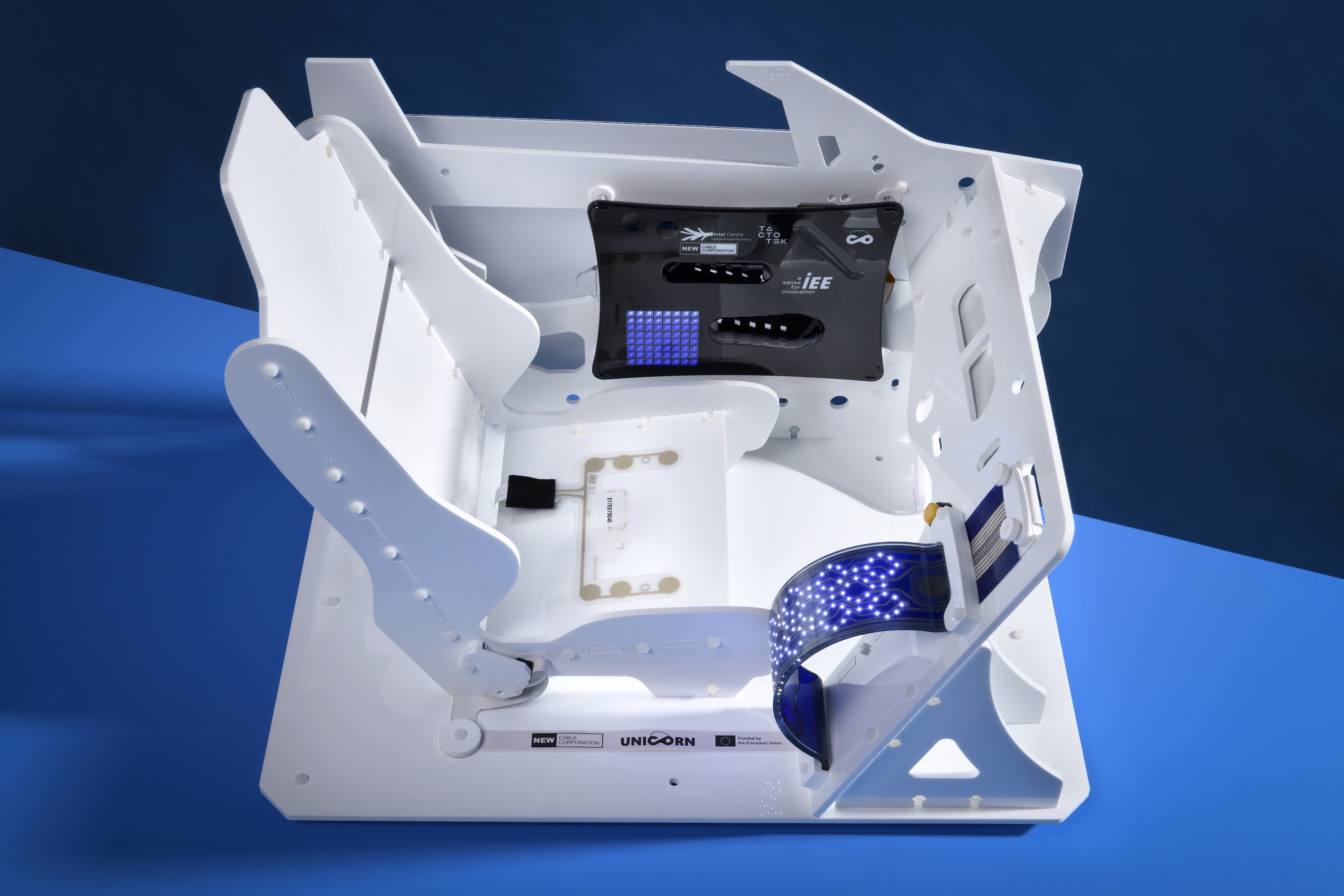
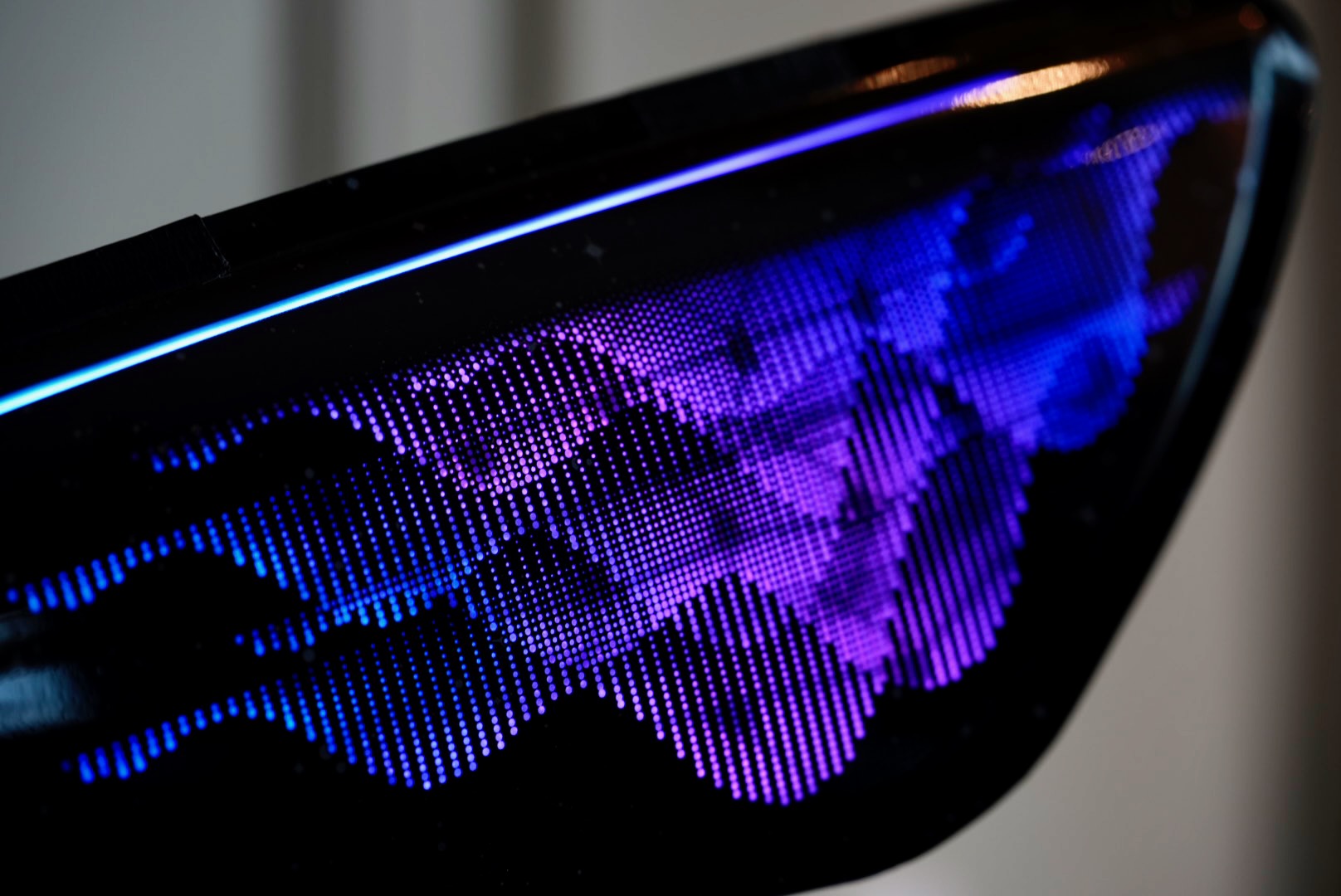
The IMSE panel in the system demonstrator combines several features:
Part of the project was a comprehensive Life Cycle Assessment (LCA) conducted as a combined effort with VITO to evaluate the environmental impacts of three IMSE designs developed in the UNICORN project. The findings from the study provided practical value for designing IMSE parts in an even more sustainable way:
Previous comparative LCA studies have measured IMSE against traditional electronics. This research was the first to systematically quantify how different design principles directly influence the environmental performance of IMSE technology.
Part of the research findings of the Unicorn project can be already exploited in the short term. They provide valuable information for companies designing and mass manufacturing IMSE parts, and the information is already available to TactoTek’s licensees in the TactoTek Online delivery platform:
Firstly, the project resulted in an expanded library with more sustainable material options: New bio-attributed and recycled materials were validated and added to the IMSE material library, giving designers and manufacturers access to lower-impact options already verified for IMSE technology. Additional materials are also planned for release in the near future.
Secondly, LCA insights are also available to licensees in TactoTek Online, providing a deeper understanding of the topic. The total environmental impact of the IMSE designs were evaluated in 16 different environmental impact categories. If looking purely at a single score, conductive ink has a notably high impact in these designs, accounting for 75% of the total single score, mainly due to its high contribution to resource use related to metals and minerals (91%).
Thirdly, Influence on Sustainability-Driven Standardization. TactoTek actively contributes to sustainability-driven standardization through its role in the IEC working group on printed electronics sustainability, established in October 2024. Within this group, TactoTek has presented key outcomes from the UNICORN project, helping to inform about the latest developments in circular and environmentally responsible electronic integration.
The UNICORN project has shown that circularity and premium design are not in conflict. In fact, functional integration, the core of our IMSE technology, is an effective way to achieve sustainability goals. By using less materials, choosing recycled materials, simplifying the supply chain, and reducing energy use during both manufacturing and use of the parts, the environmental footprint is naturally reduced.
Sustainability benefits often come hand in hand with business value, too. In this study when a simplified material stack was used, the production process was also more efficient, enabling the production of more parts with the same amount of material and process time. This translates into less potential investments in production lines and more output with existing manufacturing capacity.
For OEMs and Tier suppliers as well, circularity is no longer an optional "green" differentiator. It can and should be a fundamental design requirement, because the biggest impacts on sustainability are made in the design phase. The tools, data, and manufacturing processes are ready for use and will continue to evolve as we keep on developing the sustainability of IMSE.
*) The UNICORN project has received funding from the European Union’s Horizon 2020 research and innovation programme under grant agreement No 101070169.
A total of twelve organizations participated in the project. In addition to TactoTek, the participants were:
CEA (France) – A French government-funded technological research organization focused on energy, defense, and advanced technologies.
Continental Reifen Deutschland GmbH (Germany) – Continental Tires group is part of Continental AG, and one of the leading tire manufacturers globally.
Faurecia Intérieur Industrie (France) – A subsidiary of the FORVIA Group is a globally known Tier 1 supplier in automotive equipment, specializing in the design and manufacture of interior systems.
IEE S.A. (Luxembourg) – A global manufacturer & supplier of advanced sensing solutions for automotive, building management, footwear/sports & healthcare.
New Cable Corporation (Finland) – Finnish-based manufacturer and designer specializing in advanced Shielded Flat Flexible Cables (SFFC) and connector technologies.
Symbiose / SE2D (France) – France-based advanced printed electronics company focused on the development of In-Mold Electronics parts.
TNO (Netherlands) – An independent Dutch research institute that focuses on sustainable innovations in health, safety, and technology.
Valeo Systèmes Thermiques SAS (France) – A division of worldwide Tier 1 supplier Valeo SE. Specialized in the design, manufacturing, and supply of thermal management systems for vehicles.
VDI/VDE Innovation + Technik GmbH (Germany) – A leading service provider specializing in innovation, technology consulting, and research promotion.
VITO (Belgium) – A leading, international research and advisory centre specializing in sustainable technologies and environmental solutions.
VTT (Finland) – A Finnish state-owned research centre providing applied research, innovation services, and technology development to businesses and society.


.jpg)
